
Latest report from the friendly Kindle invasion ...
Friday, June 3, 2011
Wednesday, June 1, 2011
Thoughts: Are you too agile for TDD/BDD?
There was no requirement for Twitter!
- Kevlin Henney, Putting the "re" into Architecture
Return on investment from software is far from certain.
- Jeff Patton, Using Design Thinking to Stop Building Worthless Software
Two recent blog posts seem to indicate that there are software development environments where core agile development practices like TDD and especially BDD do not fit. Those "high-ceremony" practices are even considered as waste:
Test-Driven Development and Embracing Failure
by Steve Freeman
Steve draws the difference between ordered and unordered domains and between fail-save and save-fail approaches.
TDD/BDD are fail-save approaches. We are assuming an ordered domain: we know the relation between cause and effect and we can write specifications/expectations and we can verify them pretty reliably.
Here we have a "specify-verify" feedback-loop:

In unordered domains we don't know the relation between cause and effect. Here it is pretty difficult to write specifications/expectations and to verify them a priori. It's mostly only possibly to gain insights after having been exposed to the "real world".
Here we have a "try-error" feedback loop:
 The most important thing is that the effects of failure will not have too bad and that you can react very quickly and make improvements based on the insights of those failures (and successes).
Agile is about embracing change. Some domains are best tackled by embracing failure.
The Dark Side Beckons?
by Obie Fernandez
Obie argues that classic web startups have to find their place in the market. The real test here is feedback that is gained from success (or failures) of the deployed app.
It's much more important to be testing against business metrics (user-count, ratings, click-throughs ...) than anything having to do with code. Those insights can only be gained from the market itself.
So the feedback-loop here goes not "spec-implement-verify" but it must include deployment and market response: "spec-implement-deploy-inspect".
Having an instant deployment pipeline is crucial to be able to react in this feedback loop.
My personal feeling is still that TDD (and even BDD) might make sense in the implementation phase of projects that tackle unordered domains.
I see that TDD/BDD in the sense of "discovering" behavior, in the sense of requirements gathering makes not much senese here. But they still help to ensure the correctness of the implementation, without a "correct" implementation, inspection makes no sense ...
But the "high-ceremony" aspect must be kept low and very pragmatic.
... however I might be clinging to my perception of the world... there are also people that claim that you can do agile development inside the phases of a waterfall...
Labels:
BDD,
methodology

Monday, May 30, 2011
Quicktip: GitHub Shortcuts
Ok, I am probably the last to discover this ... but I just found GitHub shortcuts:
On GitHub just type
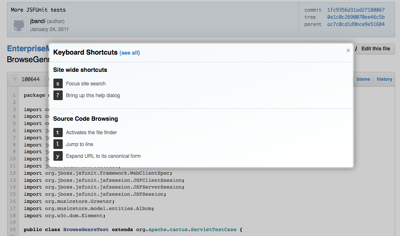
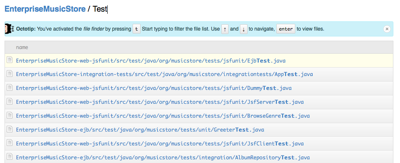
Incredibly useful is the file finder: Just type
On GitHub just type
Shift-? to get a list of available shortcuts on the current page:Incredibly useful is the file finder: Just type
t and then begin typing a filename ...
Labels:
programming,
quicktip
Tuesday, May 10, 2011
QuickTip: WebMatrix Installation failure
 Installing WebMatrix over the Web Platform Installer kept failing on me…
More precisely the dependency “Microsoft ASP.NET Web Pages” failed to install, leading to all dependent components not getting installed.
Uninstalling “Microsoft ASP.NET Web Pages” from the “Programs and features” Control Panel also failed.
Finally this was the solution that solved the problem for me:
- Remove the trailing backslash from the following registry keys:
HKEY_LOCAL_MACHINE\SOFTWARE\Microsoft\ASP.NET\4.0.30319.0\Path
HKEY_LOCAL_MACHINE\SOFTWARE\Wow6432Node\Microsoft\ASP.NET\4.0.30319.0\Path - Uninstallthe old version of "Microsoft ASP.NET Web Pages".
- Add the trailing backslash back to those keys.
- Start installation of WebMatrix over the Web Platform Installer again
Labels:
quicktip
Sunday, May 8, 2011
I am ready: Summer, Sun and Kindle
No more frickin staring at my own reflection in the iPad Screen :-)

Don't get me wrong, I still like my iPad. GoodReader is great for reading pdf and pdf is still the most consistent format when it comes to programming books (layout quality of code examples in mobi is very inconsistent from book to book).
But when you are looking forward to spend considerable time in the sun, the iPad is not the optimal device.
And yes, internet access over 3G is free with the Kindle. Working good enough with gmail and twitter (kintweet.com) ... at least here in Switzerland, I am curious if it will work in my vacation.
(I did buy the Kindle here in Switzerland over amazon.com, it was delivered within 4 days)
Update 2011-06-09: The free internet access over 3G is also working in Oslo Norway. I can browse the web and read my email.
Update 2011-07-14: Free internet access also worked in Singapore, Bali and Lombok ...
Friday, May 6, 2011
Published: SpecFlow Article in the NDC Magazine
As I announced before, Gaspar and I are going to present two sessions about BDD and SpecFlow at the NDC in Oslo this June.

We also wrote an article for the NDC Magazine: "The Birth of SpecFlow"

The magazine was now published in paper and online. You can download it for free.
Labels:
presentation
Tuesday, April 19, 2011
After all, ORM might really be the Vietnam of Computer Sience ...
The best DSL I've ever seen for working with data is SQL.
- Rob Conery, Thoughts on WebMatrix
The last mile is what kills object-relational mapping. Rails ActiveRecord does not try to go the last mile.
- Paul Wilson,
The Vietnam of Test Driven Development
The Vietnam of Test Driven Development
Abstracting SQL often isn't a good idea from my experience
- @codemonkeyism on twitter
 I have a high opinion of StackOverflow. What they accomplished in a very short time is amazing.
Reading the news that StackOverflow is writing its own object-relational mapper made me think ...
As a consultant I have seen almost no project that did not run into troubles with their ORM infrastructure at some point in time ...
... so maybe Ted Neward was right when he claimed that ORM is the Vietnam of Computer Science more than five years ago.
I cannot make my mind up on this one...
On one hand, I am a big fan of ORM. I am regularly teaching JPA.
On the other hand, I am tearing my hair out, again and again, fighting with ORM frameworks, trying to persuade them to do what I actually want (usually having a very clear idea what I want but having to shave yaks to get there, while in most specific cases it would be easy to just write the SQL I want).
Maybe it is the ORM frameworks that are the problem?
For advanced usage scenarios it often feels like ORM frameworks are adding a lot of accidental complexity.
But then again, I think ORM itself represents an essential complexity that always surfaces one way or another... sooner or later ...
The ORM-Vietnam-Hypothesis talks about quick initial successes and the Law of Diminishing Return.
Now here are some interesting questions:
- How valuable are the initial successes?
- How long lasts the phase of initial successes?
- How can you prolong this phase?
- How can you reliably detect that the law of diminishing return kicks in?

Is it possible to somehow leverage the phase of initial successes and then stop at the right moment and turn to a better solution without loosing all the initial sucesses?
Is that what StackOverflow is doing, turning away from Linq2Sql now, going for a custom ORM solution?
StackOverflow started in 2008 and has gone through an amazing evolution since.
They started with a very simple programming stack and very modest hardware, with only some part-time programmers (as far as I remember from the Hanselminutes podcast). Yet they were able to create a product that influenced the live of most modern programmers...
To achieve this, they had do choose the most pragmatic solutions. I guess Linq2Sql was the obvious choice ...
 Would StackOverflow be better off if they started with their own ORM implementation from the bginning?
Probably not ... I guess they would be at the same point now: They would have to rewrite it today based on their real world requirements and their experience from the last 2 years.
It seems that this leads us back to the principle that Premature Optimization is the Root of all Evil...
Could this be a general advise: ORM frameworks being there to get you off the ground easily, but prepare for a rewrite later, at least for some parts of your application?
Don't invest too much in your ORM infrastructure, so that you can't turn your back on it once the Law of Diminishing Returns kicks in?
... and how to achieve this efficiently?
While I was writing this post Hanselminute 262 was published, interviewing Sam Saffron and Rob Conery about their Micro-ORM implementations Dapper and Massive.
Interesting ... Micro-ORMs as the shiny new thing between the overblown swiss-army-knife-style-ORM and the not-invented-here-do-it-yoursef-style-ORM?
The podcast also talks about the fact that a simple "in-line" style of writing apps with fewer abstractions is becoming stylish again ... right the style we condemned and tried to get away from 15 years ago... and how this is related with a modern "getting things done"-mentality ... very interesting indeed.
Labels:
object-relational mapping
Subscribe to:
Posts (Atom)
